Product knowledge, as a conversation
Samsung retail sellers needed product information while they were already talking to customers. I researched, designed and helped build an AI assistant they could use through voice, text or a familiar content library.
Samsung retail sellers had to work with a large amount of device information and sales knowledge while helping customers.
I worked on Teiky, an assistant designed to make that information easier to reach without asking sellers to dig through layers of content in front of a customer. My role covered research, conversational and voice UX, the React Native app and parts of the infrastructure that ran and updated it.



Real screens from Teiky, as published in my previous portfolio.
Snapshot
- Timeframe
- September 2024 – September 2025, at Kibernum
- Users
- Samsung's sales team and external sellers of Samsung products across Chile, on the shop floor
- Product
- AI-powered sales knowledge assistant: device specifications, product information, sales knowledge and strategies through a conversational experience
- Stack
- React Native · voice chat · local content library · an LLM behind an API · Docker, Gunicorn, Nginx on Ubuntu · Microsoft Azure · OTA updates
Designing for a sales conversation
I ran interviews, usability tests and competitive benchmarking with sellers. The constraint I designed for was not a lack of information. It was retrieving the right detail while talking to a customer and comparing devices at the same time.
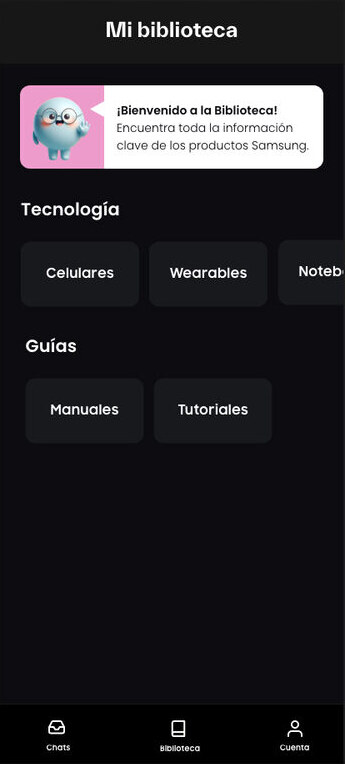
That pushed the experience away from deep navigation and toward faster, conversational access to knowledge. Conversation has a cost, though: it hides what the assistant knows. A browsable local content library, stored in the app, gave sellers a predictable path to the sheet they already knew existed.
The app also knew what state it was in. With no connection it offered the local library instead of a dead chat, and errors were handled inside the conversation rather than left to the operating system.
Interaction states as designed. The screens above show the chat, thinking and library states.
Voice was useful, but not always
Voice interaction was an obvious direction for a conversational assistant, but a retail floor is not a quiet environment.
I treated voice as another way into the same experience rather than designing the product around voice alone.
Text still needed to work well when speaking to the app wasn’t practical, and the listening state had to be visible, because the seller is not looking at the screen while talking.
I also worked on the implementation
I wasn’t just handing screens to engineering. I developed the mobile experience in React Native, including voice interaction and the local content library. On the infrastructure side I worked with Docker, Gunicorn, Nginx, Ubuntu and Microsoft Azure, and implemented OTA update workflows so the application could iterate without treating every change like a new store release.
The language model sat behind the API and is not named here.
What shipped
- Conversational AI experience
- Voice interaction
- React Native mobile app
- Local content library, with offline access
- Backend / runtime configuration
- OTA update workflow
Teiky was used by Samsung’s sales team and by external sellers of Samsung products across Chile, until Samsung Global standardized all markets on a single web chatbot.
What I took from the project
The interesting part wasn’t putting a chatbot inside an app. It was deciding how AI fits into a workflow where attention is scarce and the answer has to be useful immediately.